Trevor Harrison spent his early years at the Woodville Spastic Home (the Home) in the 1960’s, starting there at the age of two and a half years old. Trevor recalled the place from a customer perspective, rather than a service provider perspective. He remembered the big lawn out the front of the original house ‘Woodford’, where he played with his friends. Then there was the school, the classroom and the therapy. He had memories of being laid on a plaster bed to provide a cast, which would later be padded and used as a base for him to sit on. The cots he slept in were like boxes covered in fly wire – ‘meat boxes’ he and his friends would call them. Mostly, though, there was the ever-present sense of ‘just having treatment…and of outside, playing around’.
Trevor felt that, in the early 1960’s, the work of the Home was ‘still very experimental’. Because work with cerebral palsy was largely in its infancy. ‘We were experimenting with treatments…it was mainly focused on what to do with a kid to try and get him walking if we could, rather than looking at our personal independence. It was fair to say that it was assumed in those days that you would not lead a normal life.
There was a great sense of family and friendship at the Home, according to Trevor.
By the late 1970’s there was a wider view of how the Association (which governed the operation of the Home), could serve the needs of those people in the community living with disability. They were aware that preparation for the future was essential, and liaising with other organisations, their own association and those with severe and multiple disabilities to gain a future view of the requirements of children, adolescent and adult customers.
This move, and many other organisational and service delivery reviews, saw enormous and radical change for many organisations, at the same time Spastic Centres of South Australia were bringing about change in their service delivery and their Board. These changes, meant that in 1988, Trevor Harrison, a person with disability, was appointed to the Board. This was an action of enormous significance.
In an array of changes to follow, including the demolition of the old therapy, nursing home accommodation and school facilities at the Woodville Campus, but most noticeably the notion that Spastic Centres of South Australia had control of the life of a person from birth to death. For those with disabilities, themselves, this move, was dramatic and painful for some. Trevor Harrison argued,
“There’s still a lot to happen but it’s going to continue to happen the more that people with disabilities are out in the community. We’ve got to look at that, and I think we’ve got to accept the fact that people should be out in the community. How can you educate a community if you’re still hiding people behind brick walls? It’s got to be the move by the people with disabilities, to get out there and do whatever they want to do and be seen by people. Once they’ve been seen, then they’ll be accepted as well… Just because the building [at the Woodville campus] is going, it doesn’t mean the memories are going either. In this day and age, we’ve got to strive for the future”
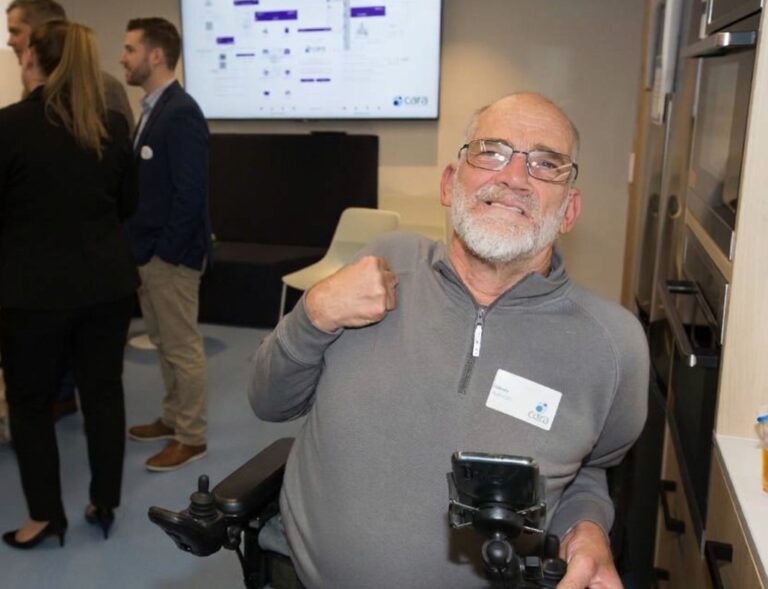
Image description: Trevor Harrison


From the roar of the crowd at Coopers Stadium to celebrating premiership success with the...

What’s in a name? Quite a lot, actually. The NDIS has reintroduced the familiar term...
We’re not a disability service; we’re a Possibility Service. While much has changed since the...